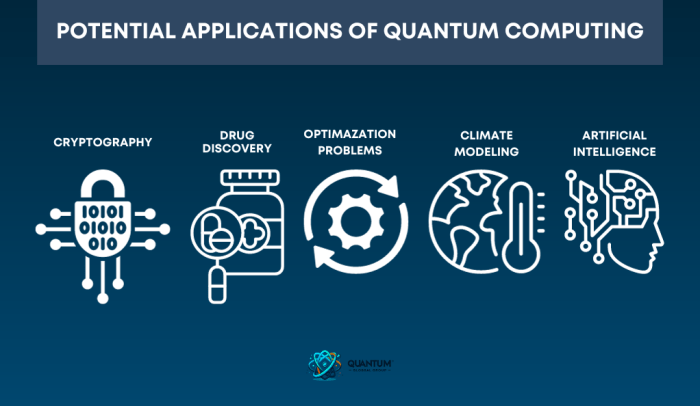
Quantum computing applications are paving the way for revolutionary changes across various sectors, offering unprecedented capabilities that classical computing struggles to match. The principles of quantum mechanics enable quantum computers to process information in fundamentally different ways, opening doors to breakthroughs in fields from cryptography to healthcare.
As industries explore the potential of these advanced technologies, we see how quantum computing not only enhances existing processes but also creates entirely new opportunities for innovation. By harnessing the strange nature of quantum bits, or qubits, we can tackle complex problems that were once thought to be intractable.
Introduction to Quantum Computing
Quantum computing is an emerging technology that leverages the principles of quantum mechanics to process information in fundamentally different ways compared to classical computing. At its core, quantum computing utilizes quantum bits or qubits, which can represent and store data in multiple states at once, thanks to phenomena such as superposition and entanglement. This capability allows quantum computers to perform complex calculations much faster than traditional computers, making them significant players in the technological landscape of the future.Unlike classical computers that rely on bits as the smallest unit of data, which can either be 0 or 1, qubits can exist in a state of 0, 1, or both simultaneously, enabling a higher level of computational power.
The potential impact of quantum computing is vast, promising to revolutionize fields such as cryptography, drug discovery, financial modeling, artificial intelligence, and material science by addressing problems that are currently impossible for classical computers to solve in a feasible timeframe.
Applications in Cryptography
Quantum computing holds the potential to greatly enhance encryption methods and security protocols, which are foundational to the integrity of data in our digital world. Traditional cryptographic systems rely on mathematical problems that are difficult to solve, but quantum computers can solve these problems efficiently, posing a challenge to existing security measures. Some notable quantum algorithms that exemplify this revolution in data security include:
- Shor’s Algorithm: This algorithm can factor large integers exponentially faster than the best-known classical algorithms, threatening RSA encryption, which secures much of today’s online communications.
- Grover’s Algorithm: This allows for searching unsorted databases quadratically faster than classical algorithms, which could undermine the security of symmetric-key cryptography.
The implications of these advancements on current cryptographic standards are profound, requiring a reevaluation of how sensitive information is protected in order to mitigate the risks associated with quantum capabilities.
Quantum Computing in Healthcare
In the healthcare sector, quantum computing can transform drug discovery and personalized medicine by enabling simulations of complex biological systems at an unprecedented scale. This technology facilitates the rapid analysis of molecular interactions, potentially leading to the development of new therapeutics tailored to individual patients.For instance, quantum simulations can model protein folding and molecular dynamics, which are critical in understanding diseases and designing effective treatments.
Additionally, quantum computing has the potential to enhance medical imaging technologies, leading to clearer and more accurate diagnostics that can significantly improve patient outcomes.
Financial Services Transformation
The financial services industry is also poised to benefit from quantum computing. By optimizing trading strategies and financial modeling, quantum computers can process vast amounts of data and execute transactions at lightning speed. The advantages of using quantum algorithms in risk assessment and management are particularly noteworthy, as they can analyze numerous variables simultaneously, providing more accurate predictions of market trends.
Several financial institutions, including major banks and investment firms, are currently exploring quantum technology to stay competitive in an increasingly data-driven landscape.
Quantum Computing in Artificial Intelligence
Quantum computing is set to enhance machine learning algorithms significantly. With its ability to process large datasets more efficiently than classical systems, quantum computers can accelerate training times for AI models, enabling more sophisticated predictive analytics.The potential breakthroughs in AI attributed to quantum computing include improved natural language processing, computer vision, and optimization techniques. These advancements could lead to more intelligent systems capable of solving complex problems that currently elude classical AI approaches.
Advancements in Material Science
Quantum computing aids in the discovery of new materials and substances by enabling detailed simulations of atomic interactions and properties. This capability is crucial in fields such as aerospace, electronics, and nanotechnology.Examples of materials that could benefit from quantum simulations include:
- High-temperature superconductors, which could revolutionize energy transmission.
- New alloys with enhanced properties for aerospace applications, improving fuel efficiency and safety.
The implications of improved material design driven by quantum computing are vast, potentially leading to innovations that transform manufacturing and technology sectors.
Exact and Formal Sciences
Quantum computing is closely related to exact sciences like mathematics and physics, where it draws upon principles such as linear algebra and quantum mechanics. These formal sciences play a vital role in the development of quantum algorithms, influencing how problems are formulated and solutions are derived.Research fields integrating quantum computing with formal scientific principles include:
- Quantum information theory, which explores the implications of quantum mechanics on information processing.
- Quantum cryptography, focusing on secure communication methods that exploit quantum properties.
This intersection of disciplines fosters innovation and drives the development of new technologies grounded in rigorous scientific research.
Future Prospects and Challenges
The future of quantum computing technology promises exciting advancements, including improved qubit coherence times and error correction methods, which are crucial for practical applications. However, several key challenges remain, such as the need for stable and scalable quantum systems, and the development of software that can effectively leverage quantum capabilities.Ongoing research and development efforts aim to address these challenges, with initiatives across academia and industry seeking to unlock the full potential of quantum computing.
As the field evolves, it will be critical to navigate the complexities of this technology to ensure a secure and beneficial integration into various sectors.
Summary
In summary, the applications of quantum computing hold immense promise for the future, driving advancements that could reshape industries and improve the quality of life. While challenges remain in widespread adoption, ongoing research and development are paving the way for a quantum-enabled world, where the limits of technology are continually pushed further.
Essential Questionnaire
What industries are most impacted by quantum computing?
Industries such as finance, healthcare, and materials science are significantly impacted, as quantum computing offers solutions for complex problems in these areas.
How does quantum computing affect data security?
Quantum computing enhances data security by enabling more complex encryption methods, making it harder for traditional computers to crack sensitive information.
Are there any current quantum computing applications?
Yes, companies are currently using quantum computing for drug discovery, optimization in finance, and even advancing artificial intelligence.
What are qubits?
Qubits, or quantum bits, are the basic units of quantum information, capable of representing and storing data in ways that classical bits cannot, thanks to superposition and entanglement.
What challenges does quantum computing face for widespread use?
Challenges include technical hurdles like error rates in qubit manipulation, the need for low temperatures, and the development of scalable quantum algorithms.


