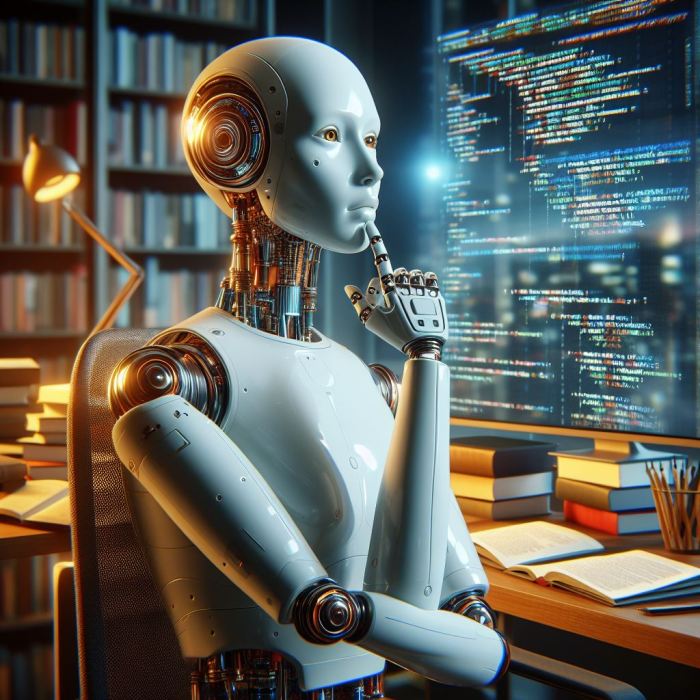
AI in mathematical proofs is reshaping the landscape of how we approach and validate mathematical concepts. As we delve into this intriguing intersection of artificial intelligence and mathematics, we uncover not only the technological advancements that allow machines to reason mathematically but also the historical context that has paved the way for such innovations.
From the early days of algorithmic proofs to today’s sophisticated machine learning models, AI’s role in generating and validating mathematical proofs has evolved dramatically, promising both efficiency and new avenues for exploration in mathematics.
Introduction to AI in Mathematical Proofs
The integration of artificial intelligence (AI) into the realm of mathematical proofs has marked a transformative shift in how mathematics is approached and understood. AI plays a pivotal role not only in automating proof processes but also in enhancing the efficiency and accuracy of mathematical reasoning. Historically, the intersection of AI and mathematics has evolved significantly, with early computational efforts paving the way for today’s sophisticated algorithms that are reshaping traditional proof methods.The impact of AI technologies on conventional proof strategies is profound.
By leveraging advanced computational power and algorithms, AI can analyze vast amounts of data and identify patterns that might elude human mathematicians. This synergy between AI and mathematics challenges the status quo, inviting a reevaluation of what constitutes a valid proof in the mathematical community.
Technologies Driving AI in Mathematical Proofs
Key AI technologies, such as symbolic reasoning, machine learning, and deep learning, are at the forefront of enhancing mathematical proofs. Machine learning specifically plays a crucial role in generating proofs by training algorithms on existing mathematical theorems and proof strategies, enabling them to learn and replicate complex reasoning processes. Deep learning models, particularly those based on neural networks, have shown remarkable potential in this field.
For example, models like GPT-3 and specialized theorem provers such as Coq and Lean utilize deep learning techniques to assist in formal proof verification and generation. These tools exemplify how AI is revolutionizing the landscape of mathematical inquiry.
Case Studies of AI in Mathematical Proofs
Numerous instances highlight the success of AI in proving mathematical theorems. One noteworthy case is the proof of the Robbins problem, a long-standing challenge in Boolean algebra, solved by a team utilizing the Coq proof assistant and AI-driven techniques. This instance showcases the power of AI in overcoming complex mathematical hurdles that had stymied human mathematicians for decades.The methodologies employed in such AI-driven proofs often involve a combination of automated reasoning, extensive data analysis, and collaboration between AI systems and human mathematicians.
Traditional proof strategies, which rely heavily on human intuition and experience, are enhanced by AI’s ability to explore vast search spaces and validate hypotheses, leading to faster and often more robust proofs.
Challenges and Limitations of AI in Mathematical Proofs
Despite advancements, AI systems face limitations when tackling complex theorems. Many AI algorithms struggle with the intricacies of certain mathematical concepts, leading to gaps in understanding and proof validity. Ethical considerations also arise, particularly regarding the reliance on AI for mathematical reasoning. The implications of deferring to AI-generated proofs raise questions about the authenticity and ownership of mathematical discoveries.Furthermore, while AI can generate proofs, the accuracy of these proofs compared to human-generated ones is a topic of ongoing research.
Instances of false positives or incomplete proofs underscore the need for careful scrutiny of AI outputs within the mathematical community.
Future Prospects of AI in Mathematics
The future of AI in mathematical proofs is promising, with potential developments that could further integrate AI into the mathematical landscape. Key advancements may include improved algorithms capable of understanding more abstract mathematical concepts and enhanced collaboration tools that facilitate partnerships between human mathematicians and AI systems.Emerging trends indicate a growing interest in the application of AI across various mathematical disciplines, including topology and number theory.
This evolution fosters a dynamic environment where collaboration can lead to novel insights and breakthroughs in mathematical research.
Exact and Formal Sciences Related to AI in Mathematical Proofs
AI’s relationship with exact sciences is crucial for the advancement of mathematical proofs. The principles of exact sciences, such as logic and formal systems, underpin the methodologies that AI employs to generate and validate proofs. Formal sciences contribute significantly by providing the frameworks through which AI can operate effectively in mathematical reasoning.Comparing the principles of exact sciences with AI-driven methods reveals intriguing synergies.
While exact sciences demand rigorous logical consistency, AI-driven approaches can introduce an element of creativity and adaptability, leading to innovative proof strategies that challenge traditional boundaries.
Practical Applications of AI in Mathematical Proofs
AI’s capabilities extend beyond theoretical applications, finding real-world utility in various fields. For instance, in engineering, AI is utilized to validate complex mathematical models, enhancing the reliability of simulations and designs. In physics, AI aids in solving intricate mathematical frameworks that underpin physical theories, streamlining research and experimentation.Moreover, educational settings benefit from AI tools that assist in teaching mathematics. These technologies provide personalized learning experiences, enabling students to grasp concepts more effectively and engage with mathematical proofs in a supportive manner.
Interdisciplinary Connections
AI’s role in mathematical proofs intersects significantly with computer science and logic. The algorithms developed for mathematical reasoning draw heavily from computational theories, creating a symbiotic relationship that enhances both fields. Philosophical discussions regarding the implications of AI in proofs also emerge, prompting debates about the nature of mathematical truth and the role of technology in shaping our understanding of mathematics.Cross-disciplinary collaborations are increasingly leveraging AI for mathematical insights, demonstrating the potential for breakthroughs that transcend traditional boundaries.
By combining expertise from various fields, researchers can explore novel approaches to complex mathematical challenges, fostering a richer mathematical landscape.
Epilogue
In conclusion, AI in mathematical proofs represents a captivating frontier where technology meets deep analytical thought. As we continue to explore the balance between human intuition and machine precision, the future of mathematical reasoning seems brighter than ever, inviting collaboration that could redefine the boundaries of what is possible in the realm of mathematics.
FAQ
How does AI generate mathematical proofs?
AI generates mathematical proofs using algorithms that analyze and synthesize existing knowledge, often employing techniques from machine learning and deep learning to identify patterns and establish logical connections.
What are some ethical concerns surrounding AI in mathematics?
Ethical concerns include the potential for biases in AI algorithms, the reliability of AI-generated proofs, and the implications of relying on machines for reasoning that traditionally requires human intuition and creativity.
Can AI completely replace human mathematicians?
While AI can assist and enhance mathematical reasoning, it is unlikely to fully replace human mathematicians due to the inherent creativity and intuition involved in high-level mathematical thinking.
What are examples of AI successfully proving theorems?
Notable examples include AI systems like Isabelle and Coq, which have been used to verify complex mathematical theorems, demonstrating the capability of AI to deliver accurate proofs in challenging scenarios.
How is AI used in educational settings for mathematics?
AI tools are utilized in educational settings to provide personalized learning experiences, assist in problem-solving, and engage students with interactive mathematical challenges, enhancing understanding and retention of concepts.


